Writing helps me think. These are my thoughts from our first day in south India.
“Have you ever been to Chennai?” I ask the heavy-set, relaxed looking woman behind me. She’s in jeans, dragging her backpack along beside her and clutches a US passport. “You look as though you know what’s happening here.”
“No. I’ve never been here.” She laughs. “I just go with the flow. I travel a lot for business.”
We’ve finally landed. After a couple hours in the Calgary airport, a nine-hour flight to Frankfurt, a quick change of planes, two movies, a sound sleep I’m transported, as if by magic, to Chennai, in Tamil Nadu, south India.
I should say I’m almost there. Before I’m admitted entry I have to get through this 150-metre line-up that is in gridlock – eight hundred other people, like me, standing still, waiting for Indian Immigration services to stamp their visas. But let’s be positive even if it is 2 AM. There are eight hundred opportunities for stories in this line-up and I’m curious. Why do people come to Chennai?
“What sort of work do you do?” I ask her.
“We have a manufacturing company in Chennai and a few customers in the area nearby.” She looks at me, sizing me up, I guess, to see if I might understand. “It’s bushings.” She says. “We manufacture bushings.”
“Oh bushings,” I say, impressed that I at least I know what bushings are. “Just got some new ones put in our car. They cost me a fortune. I didn’t know they were made in India.”
“Yes,” she says. “Customers are complaining that the price is too high. That’s why I’m here. To see if there’s anything I can do about it.”
For two thousand years merchants have been coming to the southern peninsula of India for business. The Chinese, the Greeks, the Romans, and people from Central Asia came. In the thirteenth century, Marco Polo sailed to India on his way home to Italy from China. He wrote that he was fascinated by the tremendous opportunities for trade and of the possibilities for adventure, like finding the place where St Thomas was martyred.
In many ways life hasn’t changed. Today many travellers who come to South India are here to trade. People who come from Europe and the Americas are engaged in automobile manufacturing and IT (outsourcing seems to be the buzz word.) I’m here for adventure/holiday, to explore the history, culture, and sunny beaches.
The British built our hotel in Chennai, the Connemarra, in 1854. Tidy sepia photographs, washed-out water colour paintings and a huge portrait of Lord Connemara standing beside the regal H.H. Nawar Mohammad Munawar Khan Banadur IV Prince of Arcot (1889-1903) line long, mahogany-clad hallways and tell the story of how, in 1653, not to be outdone in business by the Portuguese and Dutch, The British East India Company established Fort St George. Indian history along with the names is not tidy like the row of pictures on the wall of our hotel. The British eventually named Fort George Madras. In 1996 Madras was renamed Chennai, back to its old name before the British came.
Inside the old walls of Fort George is the home of the current legislative assembly of Tamil Nadu, a museum depicting the history of Fort George and beautiful St. Mary’s church. As I walk around the church, I can imagine the lives of promising young British officers, who came here over three hundred years ago for adventure and to advance their position in the military. Their gravestones pave the churchyard and mark their deaths caused by cholera, coup de soleil (hyperthermia) and bizarre accidents.
Way before the British, in the first century, the Apostle Thomas came to India. He too is entombed in Chennai. This afternoon while we visit dozens of little boys kick a soccer ball and make faces for our photos (no different from the little boys I know at home) in the immense courtyard of San Thome Cathedral and the little shrine where, we are told, the body and relics of St Thomas lay.
The annual Chennai Dance Festival is taking place this week at the Music Academy of Madras and the performers tonight are the best in the world. The dance, Bhartanatyam, one of the oldest traditional dance forms, is unique to Tamil Nadu and dates from the first century, the time of St Thomas. We can’t miss it so we purchase tickets for the finest seats in the T.T.Krishnamachari Auditorium for this auspicious event.
Auspicious: marked by lucky signs or good omens. Auspicious: another Indian buzzword.
Is it auspicious that we have arrived in Chennai today just in time for the last day of the festival?
Auspicious maybe.
But I feel conspicuous. As we are led to our seats in the centre of the fifth row, a sea of colourful silk saris surround me. 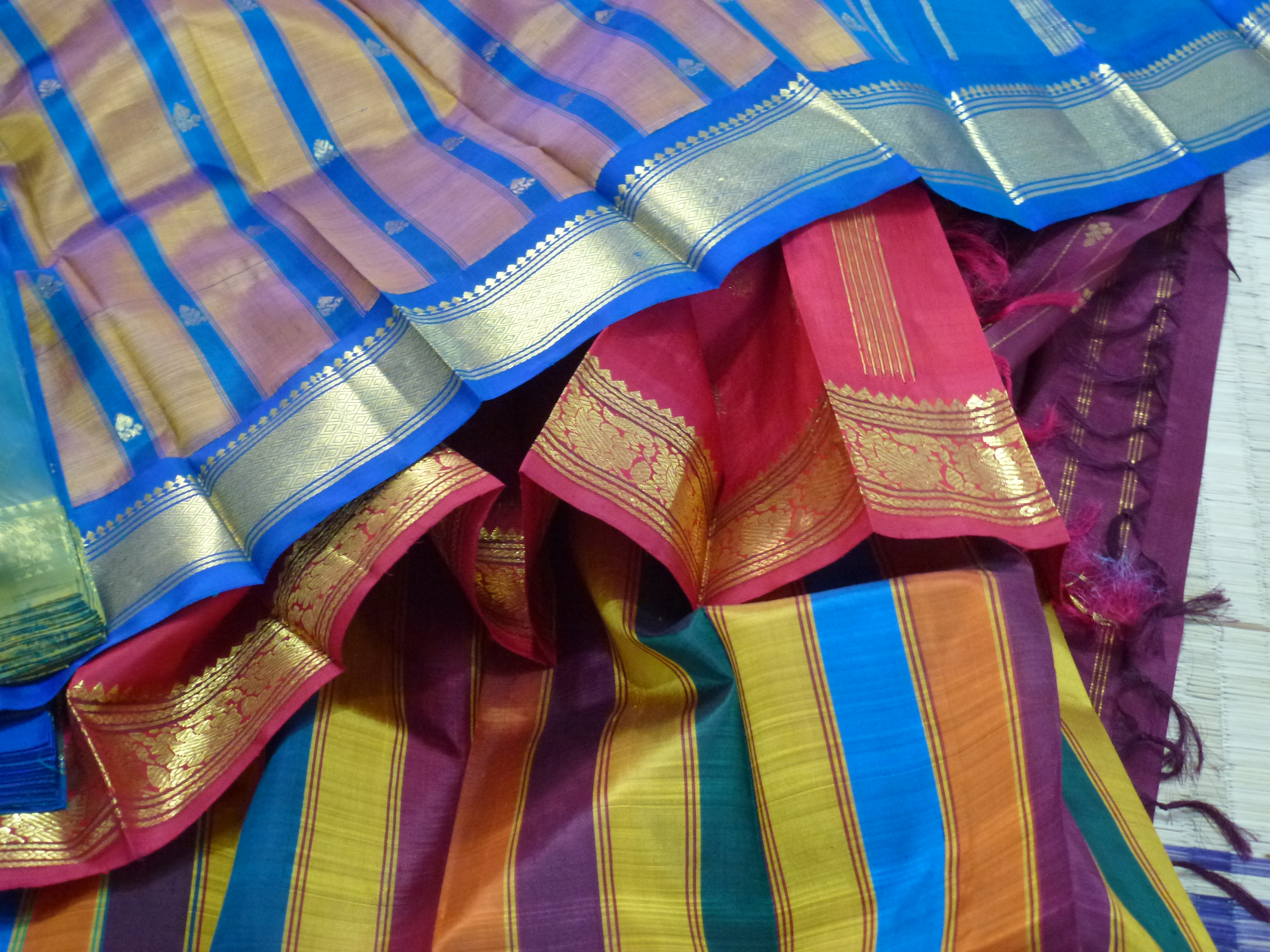 I am in khaki multi-pocketed trousers and a t-shirt.
Thankfully, the lights dim, the theatre darkens and a thin ray of light shines down on a small colourful shrine on the stage. A flute, violin, tambour and a male voice musically begin to recount stories based in Hindu scriptures and mythology. A dancer, dressed in a billowing red and purple silk costume of pantaloons and wide ribbons of gold elegantly moves forward on stage from the darkness behind. The graceful movement of her limbs, and head and eye movements work with the musicians to portray stories that have been told in India for two thousand years.
Incredible India.
I know now that being able to attend that performance our first evening in Chennai was auspicious – a stroke of luck. It helped me understand the great temples and culture of Southern India I’m visiting this week – the shore temple and famous stone carvings at Mahaballipurnam; the 9th century Natraja Temple, where the patron deity, Shiva, Lord of the Dance, details in granite carvings the 108 steps (is this  where yoga started?) of the Bhartanatyam dance; the Airavateshvars Shiva temple, a UNESCO World Heritage Monument; and, Brahadaeswar another Shiva temple and also a UNESCO monument.
Coming eventually: Coriander, cardomen, tamarind and maybe a guest post.


 Travel Musings