Yoga and a Giant Pangolin

This is an excerpt from my recently completed manuscript, a memoir about travels along the Silk Road  during the past forty-five years.      

Rajasthan. January 2011

For as long as I can remember I’ve travelled India, although vicariously, through books. Marco Polo might be my muse. When my own story about the Silk Road began almost half a century ago now, Ross and I had to change our plans to work and travel in India because of a war. When we finally got there for the first time, in 1994, I was involved with UNICEF and went on a tour to learn about children’s health and education.

This time I’m going to India to rest and to try and fuse the information I’ve gathered over the years so I can find a way to close my story.

By the time Marco began his return voyage to Venice more than two decades after he set out, he was a different person. He’d had twenty-four years’ experience visiting places in the Far East and when he journeyed around the coast of India aboard a merchant ship on his way home he was more open to diversity, able to relax and admire what he saw.  His stories paint a rich picture, drawing his readers’ attention to India’s geography and natural phenomena. “Everything is so different,” he writes over and over. He describes peculiar animals, birds, flora, food and drink. He’s fascinated by the variety of people, their languages and customs, local arts and crafts. He tells the reader of an India so vast and complicated, it would take him another year to recount all the stories.

I’m in awe of Marco. Like him, I’ve changed over the years. Travel is finding news ways of seeing everything. A yoga practice might be a good starting point; after all, yoga originated in India long before Marco came. Millions of people who live here now practice it and it fits with my travel focus of fusing information. In this case the body, the mind and the spirit.

My private yoga practice will be in the old former hunting lodge, somewhat off-putting for me – it’s different from the sparking new yoga studio I go to at home, with forty other participants crammed in together. My thoughts are mixed; I begin to wonder why I want to do this. But here I am. In Rajasthan. In my expedition-weight long underwear (damn, why did I leave my yoga gear in Calgary?) waiting for the yoga lesson and my introduction to India.

Kumar, impeccably dressed in pressed white cotton yoga pyjamas is expressionless. “Come,” he says, leading the way across a park alongside the environmental reserve to the lodge. And the yoga mats. I stumble along behind, uttering a few Canadian pleasantries to try and take the edge off and perhaps eke a smile out of his poker face, but he is steadfast. This tall man with a perfect, straight spine, neatly cropped black hair and tidy moustache is dedicated and wants me to take his instruction seriously.
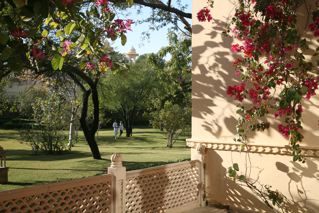
Somehow my long underwear gives me a comfy-homey feeling that overpowers the discomfort I feel when I’m totally out of place. The peacocks and peahens on the path scuttle away screaming their sympathy “Help. Help.” Are they crying that they’re here in this quiet natural setting to help me feel safe?

At the entrance to the lodge, Mr. Singh, the 80-year-old turbaned Rajput caretaker I met yesterday, claps his hands to his heart in prayer before smiling through his magnificent white handlebar moustache. “Namaste,” he says, welcoming me before he leads me up a zigzagging narrow staircase, designed two hundred years ago to confuse intruders on their way up to the second floor, and mixing me up even more.

In the Maharajas’ days of glory this lodge would have been surrounded by a hundred trumpeting elephants waiting to take hunters out to the adjacent forest to shoot tigers, Mr. Singh remembers. I like Mr. Singh’s presence. He told me he belongs to the Rajputs, a historically fierce warrior caste; now he’s here to protect me.

At the top of the stairs is a small terrace overlooking the environmental reserve. My yoga mat has been neatly placed on the shiny, cool, stone floor facing the forest.

I take a deep breath. Fresh, warm breezes, punctuated with the scent of bougainvillea and hibiscus, soothe me. A deep blue sky frames tight green clusters of the Aravalli Mountain Range surrounding Lake Pichola and Udaipur’s famous white marble palace. It is late in the afternoon and the day cools as the hot sun begins to sink into the hills.

“Take your place. Your mat is your own private space.”

Thank you. I take my place. I stand on the mat. So far so good.

Kumar kneels, and nods, affirming that I should do the same.

I kneel. My crackly knees break the quiet. I stifle a nervous self-conscious giggle.

“Relaxxxxxx. Close your eyes Mrs. Hayes. Ommmmm. Say ommmmm with me,” he says almost too quietly for me to hear but with a definite no nonsense tone. I do my best. I try to keep my eyes shut but I have an urgent need to know what’s happening. Where am I? What’s going on? What do I do now?

“Enjooooyyy the practice.” Kumar chants. I make an effort to calm myself.

I’m told the position of stillness is yoga’s most difficult. And for me it is impossible.

I open my eyes.
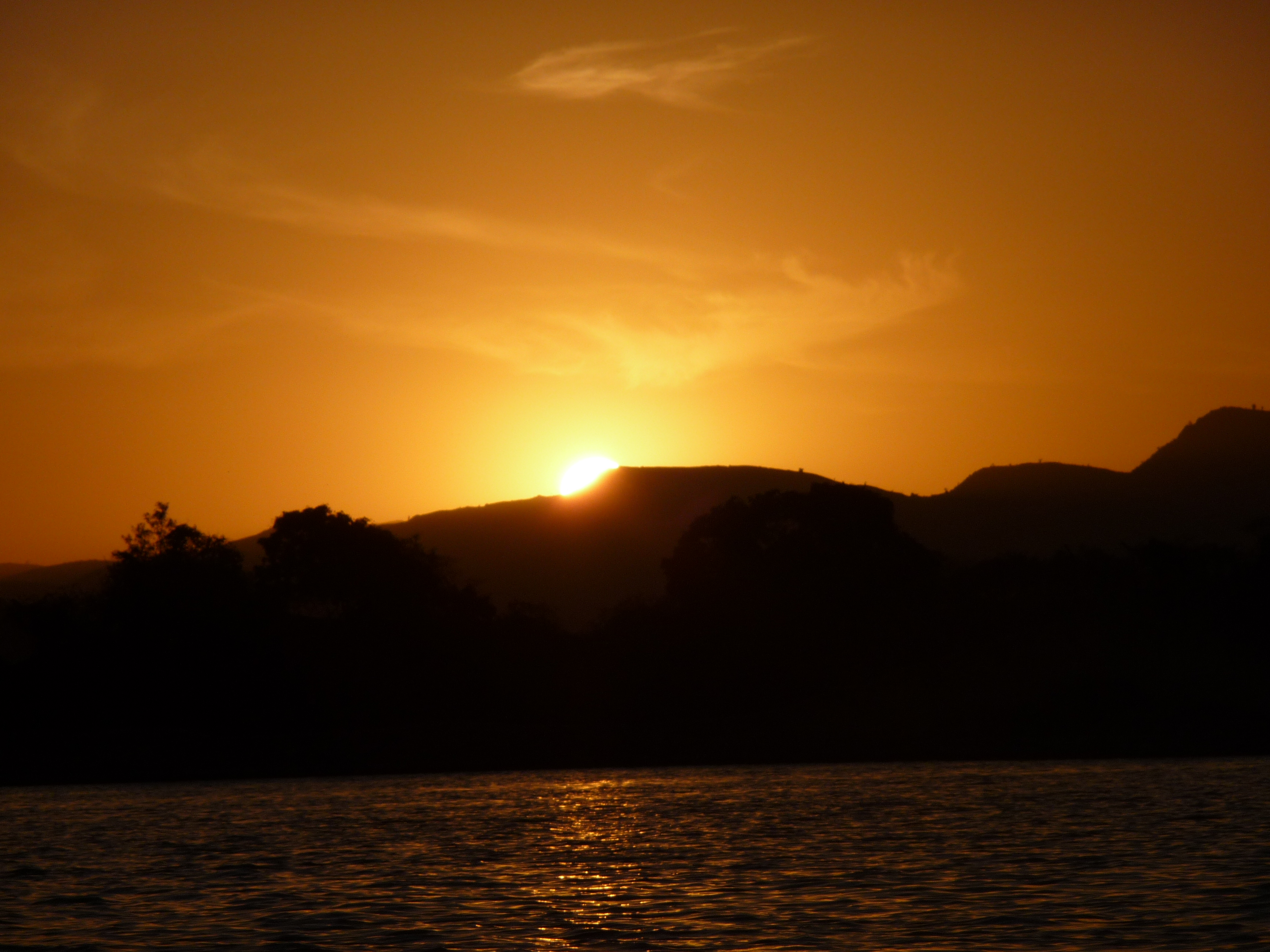
The air, the sweet smell of the park, the sun beginning to settle down behind the hills is background for a strange slow movement of some sort at the edge of the park, behind Kumar. Kumar’s eyes are still closed but mine are wide open now.

Something deep within me says, “Be still Nancy. Do not speak. This moment is special for you.” A peculiar beast about the size of a large pig emerges from the bushes and shuffles along the edge of the park. The creature is covered with huge smooth scales, the colour of Rajasthan’s dry earth, shining in  the light, from the tip of its long narrow head to the bottom of its elongated fat tail. Then it slowly, surely, disappears into the forest.

I am calmed, in awe. What have I seen?

I return to my muse, Marco, the model traveller of seven hundred years ago. “Remember this gift and take it with you,” the voice inside me says. Would I have missed the giant pangolin, the giant scaly anteater, a rare sight even in India, had I not been in pursuit of stillness, relaxing and enjoying a quiet yoga practice while I’m here?

Coming next: The Maharaja and Jazz

Sacred Surfaces: guest post by Ross Hayes

“Sacred Surfaces” reflects Ross’s enthusiasm as an architect and urban designer.  The drawings and photographs you see below are also his.

We leave the swerving, braking and horn-honking traffic of downtown Maduri inTamil Nadu get out of the car and walk along a tree-lined pedestrian boulevard leading to the 17th century Hindu Meenakshi Amman Temple. We enjoy the sudden quiet. No cars, busses or trucks. But jammed with pilgrims.

Our shoes and socks are stored outside the temple and we proceed barefoot through one of the gateway (gopurams) towers.  Fifty meters in height, the tower is a tiered structure decorated level after level with figures of people meditating, praying and dancing. There are warlords and statesmen, gods, demons and beasts. They are painted in pastel hues- corals, grey-blues, yellows and pale greens. Originally they were monochromatic, but we are told that colour was added to make the place friendlier.

I think back to Greek temples, which are today appreciated for their simplicity and the natural colour of the materials. It wasn’t always like that. In many cases the stone, brick and even marble was covered with a carefully prepared cement to pick up coloured decoration. The cement stucco was capable of such a high polish that it would reflect like a mirror. In the bright sunlight, I speculate that Greek temples must also have dazzled the visitor.

While the Meenakshi Temple is enormous and covers 45 acres, it does not overwhelm. The heartbeat of the place takes its cadence from the personal gestures of many individuals. They at times jar with one another. But they provide the pulse of the place.

I anticipate a more contemplative atmosphere as we approach the inner part of the temple. And am surprised to find that the entry, which is flanked on either side by richly carved columns, has been transformed into a bazaar.  Merchants call out. Gold and silver coloured trinkets, bright packages of pigmented powder and small statues – all glitter under the glare of bare fluorescent light.

I pass a black granite ox, head tilted up slightly, with elongated eyes and a broad blunt nose. He sits in a golden cage. Yellow and red garlands are slung around his neck and a white one is perched, slightly off centre, on the top his head. Just behind, musicians leaning against the temple walls, fill the space with sound. The nasal resonance of a reed instrument, like that of a soprano saxophone, rises and falls in long sustained notes reverberating off the hard surfaces. The percussion intricately follows his lead. I try to count out the timing, but it is more of a flow than a count.

I turn the corner and go by an elegant gold flagpole with what appears to be three layers of horizontal clouds streaming out from the top. Then I pass a group of enormous wooden wheels from a chariot used to convey deities around the temple grounds. I continue on with the crowd (there are 15000 people a day that visit the temple.) As the melancholy sounds of  music slowly fade, we enter a vast, dimly-lit hall. I try to make sense of what I see but cannot get my bearings. The flow of people dissipates into separate channels and countless eddies. I am disoriented. My eyes adjust and shapes begin to emerge from the dark surfaces, but their haphazard sequence does little to guide me. Small offerings, a grain or two of rice, personalize the hard surfaces. In some places, the placing of thousands of hands has deepened the sheen on the rock. In others, oils highlight  a shape. Some stone figures are enhanced by bright silks draped over parts of it giving it a human quality.

A group entering the hall, kneels in front of one of the figures. The crowd instinctively shifts to make space. Others, individually or in small groups moving through the space in diverse directions, pause in reflection. They touch the figures, light candles and at times dust them with brightly coloured pigments.

These deities are not alone and aloof. They are dressed up and decorated by the pilgrims, like members of their family.

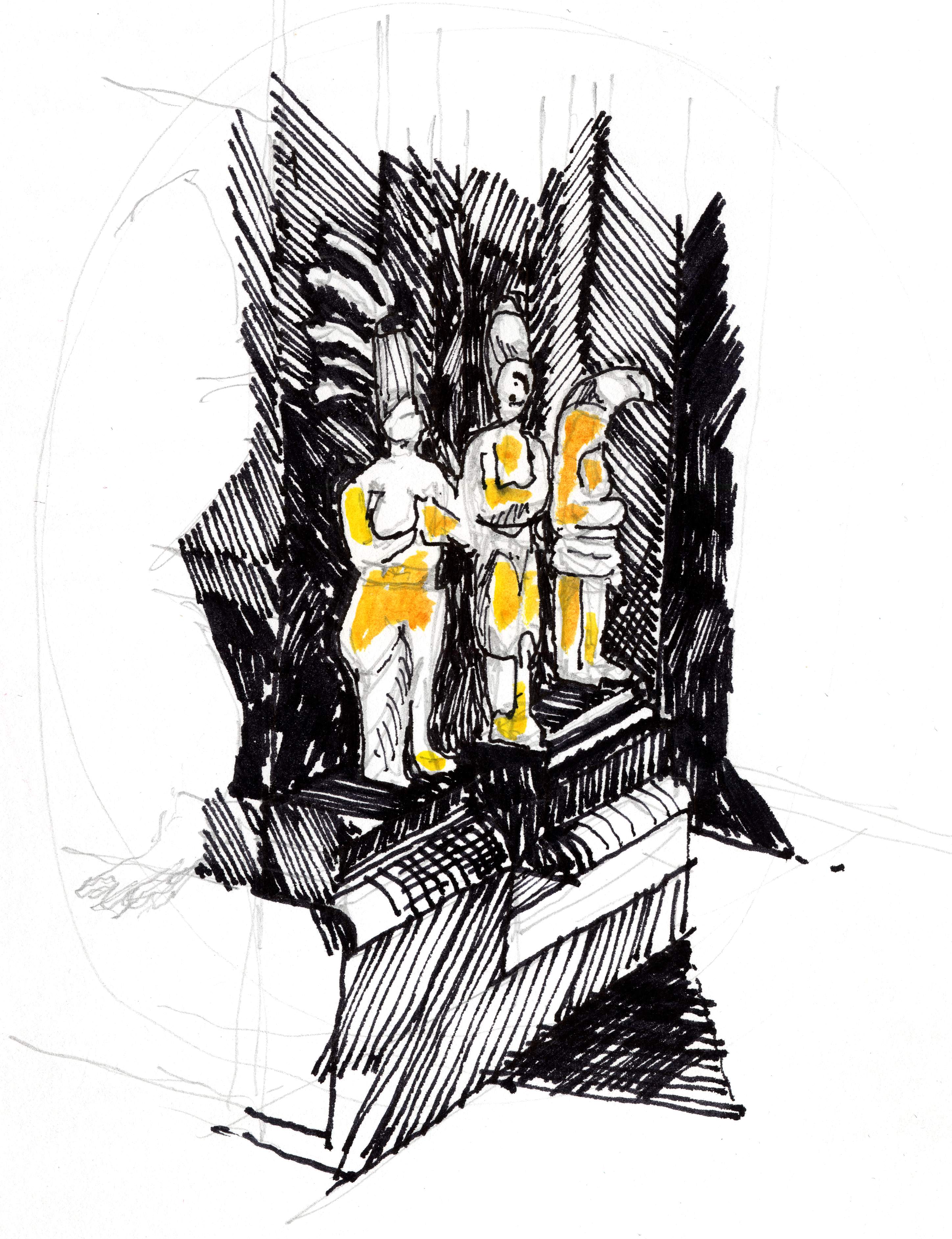
Three figures that appear to grow out of the black granite of a wall are partially coated with yellow pigment. Why yellow, I wonder? And why just part of the figure?  Nearby, feet extending from base of an enormous sculpture are dusted with red powder. The rounded shapes of a pregnant woman, draped in silks, glisten with fresh oil. A small garland has been carefully placed on her head and smudges of red highlight the edges. Not far away, a small face with a large turban has been draped in blue and yellow fabric. The surrounding wall has been dabbed with rough trident shapes. In places, the markings have been applied over each other and have blended into a rich orange- red.

Each surface has come alive. From the diverse offerings of many hands a story is told, one which is understood at a personal level by those paying their respects. Perhaps the decoration of surfaces in the temple is a way of expressing gratitude. A way of making something that is otherwise hard and cold, part of oneself. Is this an Indian tradition?

Our visit coincides with Pongol, the great Hindu harvest festival. On one of the days, farm animals are decorated.  We see two magnificent bullocks, pulling an enormous load, decorated with banners flying in the breeze from a chord between their elegant curved horns. Flowers are draped along the side of their faces and down across their chests. They appear to be proud. And certainly their owners are grateful. We are told that the harvest has been good.

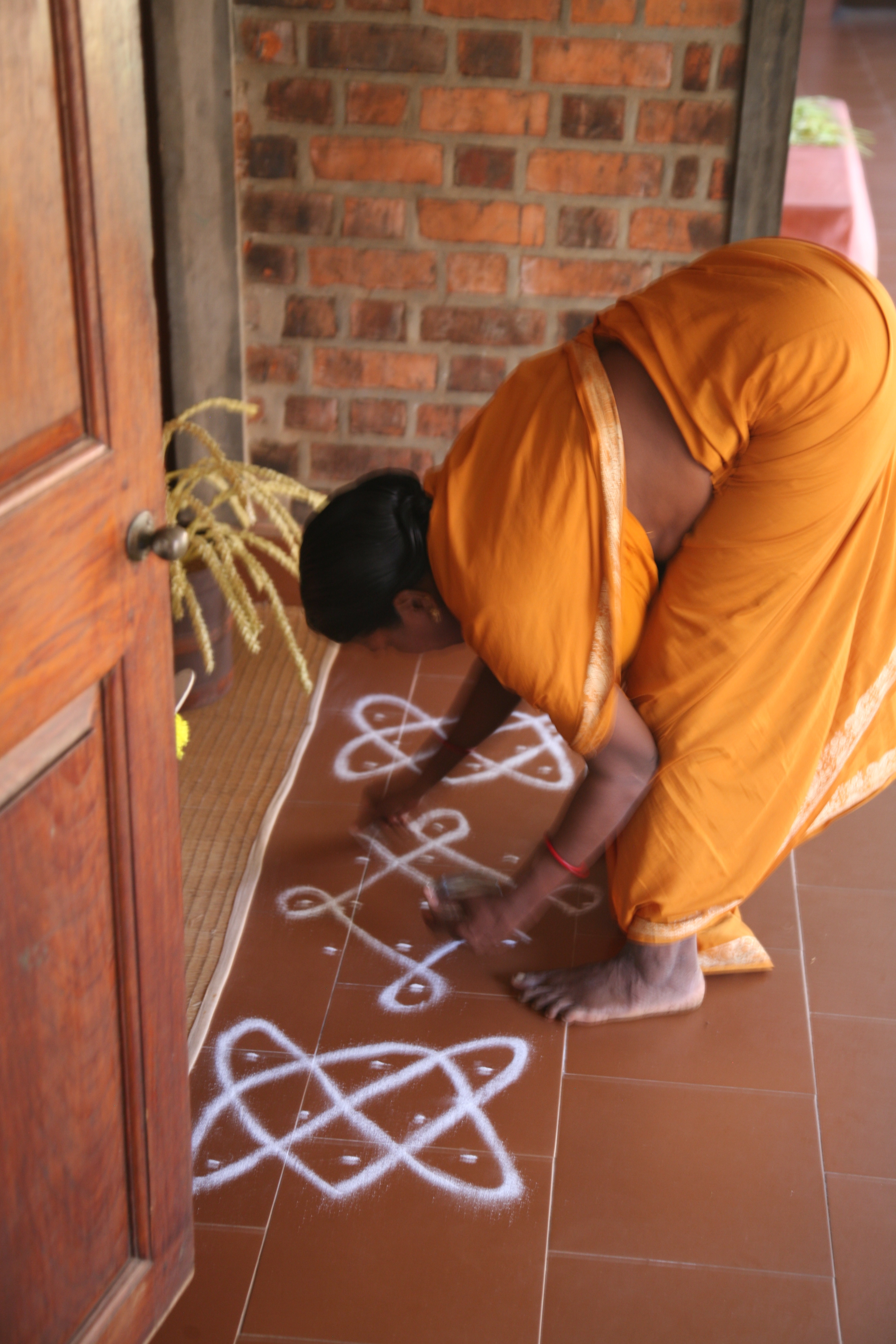
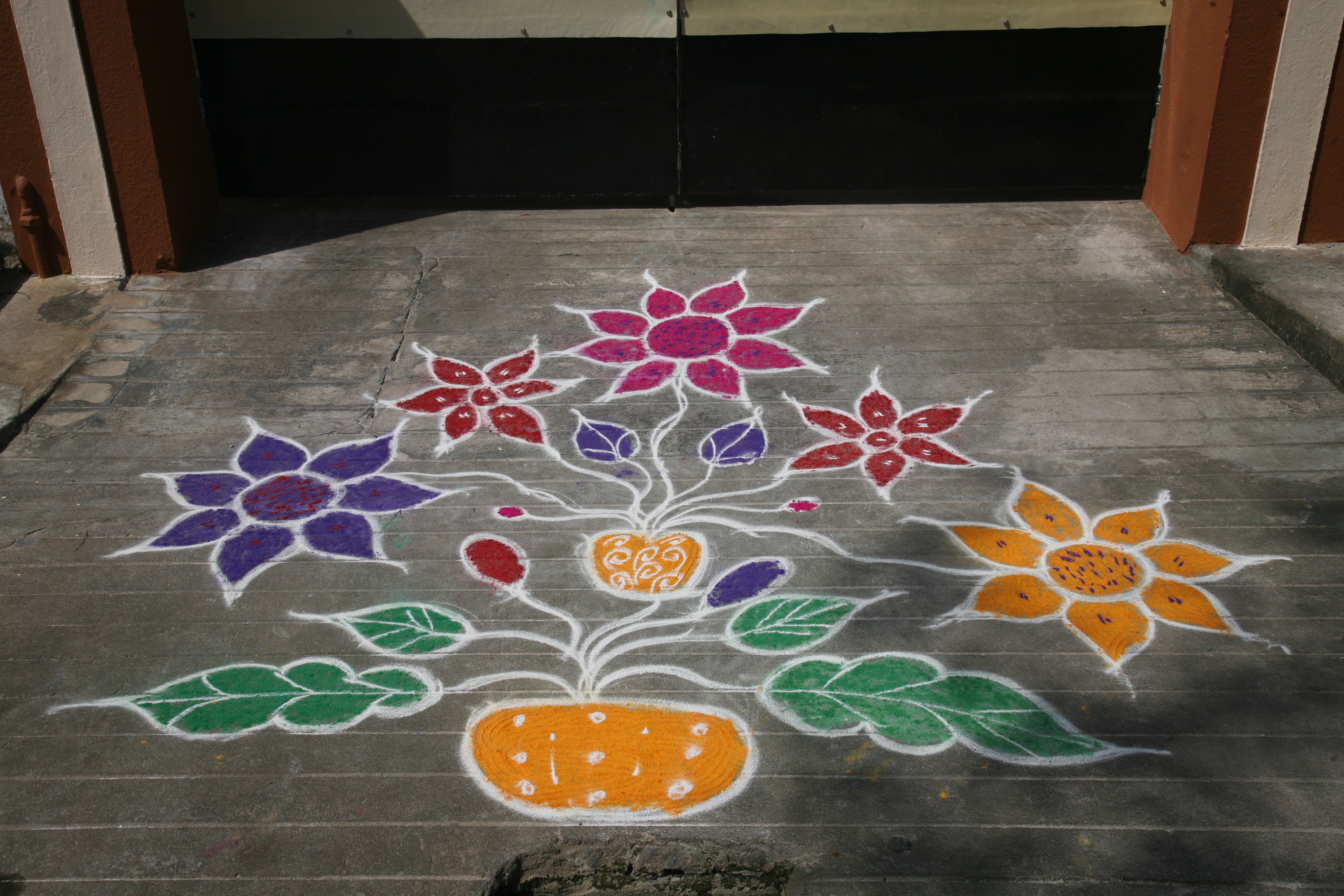
Sidewalks are often decorated with kolam designs, which in some cases include coloured depictions of natural objects, in others, curvilinear designs are set out around a series of points. In India, decorative surfaces and colour are everywhere. We talked to a group of women with their children in the courtyard outside one of the temples. Strong features contrast with bright saris; an orange, yellow and green shawl on one women, magenta, orange and gold on another. Flowers embellish their jet-black hair.

It is not surprising that the instinct to embellish a spiritual place is so strong. It personalizes an object, brings it into focus, providing a platform from which you can reach out to a larger spirit. It creates a complex, and at times seemingly discordant environment. But one which combines the unique expressions of many individuals, creating a place that is very rich.

Please click below on “leave a comment”  and share your experience and insight. I’d love to hear your stories. Ross 

Reading India

I love reading about places I visit.  For me, India has a goldmine of fine literature.

It’s no surprise that the country is fertile ground for both writers and readers.

There are thousands of years of history and 1.2 billion people live there. That means there are more than1.2 billion stories to be told and thousands of novelists, poets and other writers available to write them. Even Marco Polo wrote about India. He was so well thought of for his contribution to India that the image of his face is discreetly carved into a sidewall of the majestic Brihadeewarara Temple in Tamil Nadu.

English is the second official language, after Hindi. The towns and countryside are dotted with “English medium” schools and bookstores are filled with a tempting variety of good reading material. There is no shortage of talented, entertaining reporting in English language newspapers.

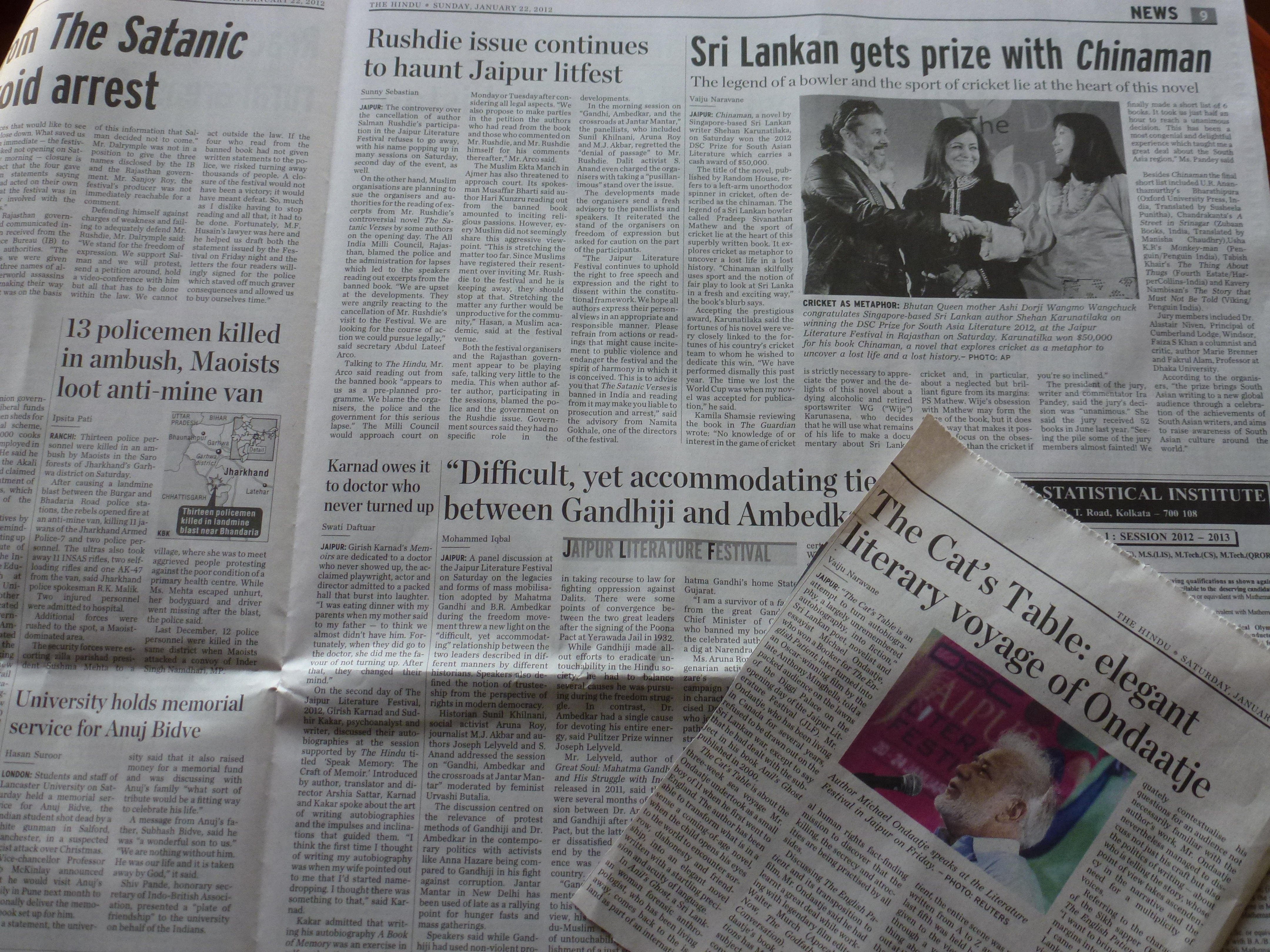
The Jaipur Literature Festival is held every year in January. In 2006, it’s first year, a hundred people attended. Five years later, in 2011, thirty thousand people went. This year The Hindu newspaper reported, “It looked as though the whole world was there. Except Rushdie, of course.”

Certainly all the other star writers were there. Salman Rushdie cancelled his visit saying death threats to him were the reason. There was rumour that the sales of  “Satanic Verses” skyrocketed after his announcement. Tweet wars were rampant. Oprah Winfrey made an appearance, Michael Ondaatje wowed audiences, and David Remnick, editor of the New Yorker magazine sparked debate when he talked about his book “The Bridge: The Life and Rise of Barrack Obama.”

Tina Brown called it “The Greatest Literary Show On Earth” 

The festival made the headlines for days while I was in India. I could hardly wait every morning to read and devour all the excitement in the Times of India or the Hindu. The stories go on and on for pages. Even now, several weeks later, I read about it on the Internet and watch the conference sessions on video. You may want to check it out too at http://jaipurliteraturefestival.org/ .  Click on “ Watch Videos.”

In the past few years I’ve delved into a small part of the rich body of literature set in India or partly in India, written by Indians living there, written by the diaspora of Asians who live outside the continent, or written by others who have been touched by India in some way.

Here are a few of my favourite reads.

The White Tiger, Aravind Adiga. This dark comedy really spoke to me of the India I know and the issues that come up regularly in conversation and reading – corruption, struggles to make ends meet, relations between India and China, and difficult family matters such as arranging marriages for children. The author grew up in Mangalore and now lives in Mumbai. This is his debut novel and it won the Booker prize in 2008.  The Booker Prize is awarded each year for the best novel written in the English language by a citizen the Commonwealth.

Life of Pi, Yann Martel is about a young boy, from Pondicherry on the Bay of Bengal. I remembered this book when we visited Pondicherry this year just after Cyclone Thane hit and devastated the area. The young lad, Pi, explores spirituality and what life means when he is shipwrecked and stranded on a small boat in the Pacific Ocean with a Bengal Tiger. This fantasy-adventure book won the Man Booker prize in 2002. The author is a Canadian who has travelled extensively and has lived in India.

A Fine Balance, Rohinton Mistry. This Giller prize-winning novel, written by an Indian-born Canadian, is set in Mumbai between 1975 and 1984. The story of a changing society is told through four diverse main characters who bond together during the time of Indira Ghandi, the “Emergency,” and increased government powers and crack down on civil liberties.

Miss New India, Bharati Mukherjee. I read a good review of this book in the Globe and Mail so I downloaded it onto my e-reader while I was travelling. It’s a compelling novel – lots of action, description, and a unique look at the new India. The story is of Anjali, a young woman who leaves her small town to find a high paying job in the high tech industry in Bangalore. The author, who was born in Calcutta, skilfully connects the high tech world of the call centre industry, snazzy coffee shops and bars to the other world of tradition and coping with change.

The English Patient, Michael Ondaatje. I’m putting this on my list because Kip, the Indian Sikh sapper, for me, is one of the memorable characters in Literature. The setting is WWll.  Kip’s comment about the west never being able to reconcile with the east, and America never doing anything like dropping an atom bomb on a white population stuck with me. The book won the Booker award for fiction and Ondaatje was one of the stars at this year’s Jaipur Festival.

The God of Small Things, Arundhati Roy. The author was awarded the Booker prize in 1997 for this, her debut (and only) novel. It is semi-autobiographical, set in Kottayam, Kerala from 1969 to 1993, where Roy grew up. This is one of my favourite places in India, close to the world renowned “backwaters.” The story is about “small things” that affect lives. Themes of the caste system, forbidden love, communism, and Kerala’s Syrian Christian community are superbly woven into the story of fraternal twins who are separated.

Midnight’s Children, Salman Rushdie. This book won the “Booker of Booker” prize  (i.e. the best all time winner) to celebrate the award’s 40th anniversary. It is also on Penguin’s list of “Great Books of the 20th Century.” Using a mix of magic realism and historical events, the story of Saleem Sinai, who was born with magical powers at the exact moment of Independence, is embedded in an account of India’s transition from Colonial times to Independence and Partition.

A Suitable Boy, Vikram Seth. This is the story of four families as a mother searches for a suitable boy to marry her daughter. It is peppered with delightfully solemn and satirical views of national politics. Published in 1993, this book is 1488 pages long so it takes commitment to read. It has won several prizes. It’s worth the time.

Indian Summer: The Secret History of the End of an Empire, Alex vonTunzelmann. This is a history book that reads like a novel. It’s full of romance, intrigue, religion, and disputes surrounding the political end of the British Empire in India. For me it was an important read to help me understand India and today’s politics.

Cutting for Stone, Abraham Verghese. The author was born in Ethiopia while his parents, teachers from Kerala India, lived there. The main characters in this gripping family saga, set in Ethiopia and the United States, are two physicians from India. It is on my list because it helped me understand better the issues facing expatriates and the Indian diaspora from Africa that now lives in North America.

What are some of the books you’ve read about the places you visit (vicariously or otherwise)?  Please click on comment and tell us about them.  I’d love to read your stories. 

Update March 20. Eleanor Wachtel’s CBC Writers and Company interview with the Indian writer and politician Sashi Tharoor is brilliant. If you missed it  click  http://www.cbc.ca/writersandcompany/episode/2012/03/18/south-asian-conversations-part-5/